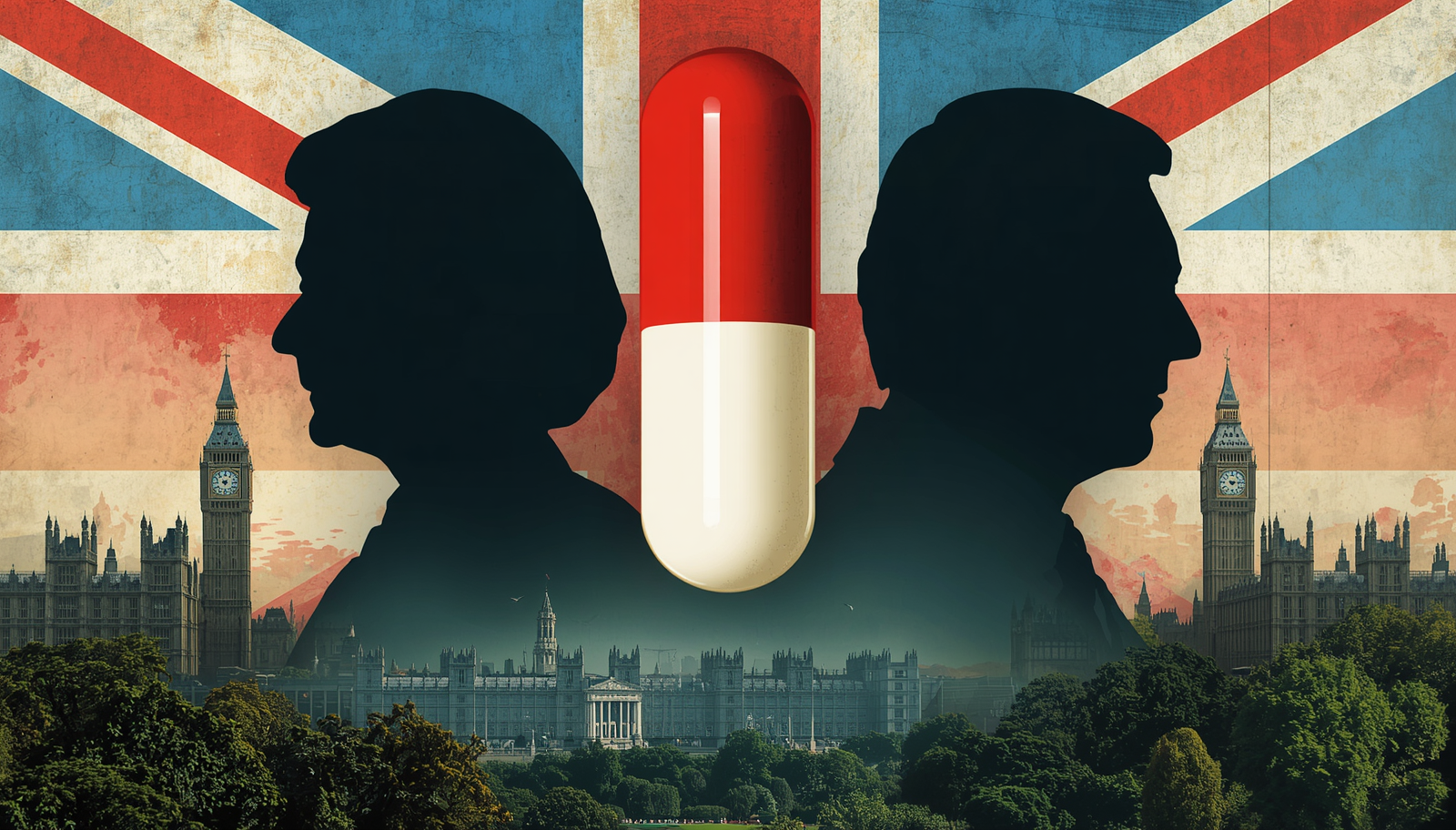
The drama of the Government over the last week or so has be thinking. Somewhere along the way, ‘we’ (whoever that is) got convinced that you can have what you want now and what you want later. That there’s a version of every hard decision where nobody loses, nothing costs more, and the trade-off just… isn’t there.
It’s a magic pill. And it doesn’t exist. Yet ‘we’ (there it is again) keep being offered it, and voting for it.
The pill we keep swallowing
Take public debt. For over a decade, we were told the country was going through austerity. Painful. Necessary. Tightening the belt. Except spending still rose overall. What actually happened was selective — local government and justice were hollowed out, the NHS and pensions were protected, and debt kept climbing. The right said “we’re being responsible.” The left said “you’re destroying public services.” But were either of those things true? And are they even linked in any way to the facts of how spending was being allocated?
What no one said was: “We’re choosing to fund some things and not others, we’re borrowing to do all of it (so we’re not growing it as fast as we have in the past for things like the NHS), and at some point that might stop working.”
That’s not a left or right problem. That’s a magic pill problem. Promise fiscal responsibility and protected services and lower taxes. Win the election. Deliver none of it. Repeat. And repeat. Across however many prime ministers once you’re reading this.
The pill we won’t take
Here’s the odd thing. When something close to a genuine easy answer does come along, we refuse it.
Ozempic, for example, actually works. It’s not perfect, it’s not for everyone, and I’m not qualified to talk about it, but it seems like those who are reckon it works. And the reaction? “It’s cheating.” “Just eat less.” “You’re taking the easy way out.” We moralise against a solution that actually delivers and yet we’re also voting for one, over and over again, that doesn’t.
Technology hasn’t helped. Everything else in life has got faster and simpler — deliveries, communication, entertainment, information. So the expectation that government should work the same way is natural. But infrastructure doesn’t compress like an Amazon order. Institutions don’t iterate like an app update. Trade-offs don’t disappear because someone put them on a dashboard. Tech has trained us to expect magic pills everywhere, which makes the political version easier to sell.
Who’s selling?
Blaming this all on voters seems a bit rich. Because this isn’t just voter demand. It’s a failed market of politics.
Politicians and the media have leant into it — hard, so much so that there’s pretty much nothing else on the ballot. Because honesty doesn’t win elections, and nuance doesn’t get clicks. The market sort-of works: the media whip up a fuss whenever a ‘painful’ solution is proposed, so politicians – obsessed with the newspapers more than the readers – supply impossible promises, and get rewarded for it by the media and then – because they’re all at it and there’s no choice – by votes.
Nobody breaks the cycle we’ve created because the first person to say “look folks, this is how it actually is” tends to lose.
Except sometimes they don’t.
Thatcher said hard things. You can disagree with what she said — plenty do — but she said it. She didn’t really talk about trade-offs, mind. She didn’t say “here’s what we gain and here’s what it costs.” She forced through with conviction — “there is no alternative” — and steamrolled the other side of the argument. But she was honest about the direction, even when it was brutal.
And maybe the criticism that she created Blair is true, but not in the way it’s usually meant. She didn’t just create New Labour as a reaction. She created the conditions for another leader willing to say “look folks” — just in a voice more people could hear, and with more honesty about the trade-offs. Blair told us hard stuff. He took positions. He made calls that weren’t popular and defended them in plain language.
And he’s still doing it. The Tony Blair Institute’s work during the pandemic — arguing for prioritising first doses over second, accepting risk to get maximum protection fastest — was exactly this. Pragmatic. Evidence-led. Willing to say “this is the trade-off and here’s why we should take it.” Not a magic pill. A real decision with real consequences, made honestly.
Where’s that now?
The latest simulation
As I write this, gilt yields are above 5%, debt interest is running at around £110 billion a year, and the political class is arguing about who gets to lead the next round of spending money we don’t have.
Andy Burnham is trying to get back to Westminster, to take over as PM. He has said Britain is “in hock to the bond markets” (although he now says he was taken out of context somewhat, since he was arguing that we shouldn’t be – because we need them less – rather than any suggestion they should be ignored), but his allies say the markets “will have to fall in line.”
And he has spoken about taking back control of housing, of water, of rail, and so on as a way of getting back control over the cost of living. All industries regulated heavily by the Government already, even where they are nominally ‘private sector’.
And it sounds like conviction. It sounds like someone saying the hard thing.
But is it? Burnham’s career doesn’t suggest it to me. There’s been plenty of switching around to suit the mood music. Thatcher didn’t pivot. Blair built New Labour over years from a coherent diagnosis, not from reading the room.
Burnham reads the room very well. That’s a different skill.
And his prescription — more state, more public ownership, roll back the market reforms — is just a different magic pill. It’s “you can have everything if we just take control of it.” It’s the same promise of painless solutions, just from the other side. The uncomfortable truth that some things need to cost more, take longer, or simply not be provided doesn’t feature.
The system doesn’t lack people who look like conviction politicians. It lacks people who actually are.
So what breaks it?
I genuinely don’t know. That’s the bit I’m stuck on.
You’d think a global pandemic which put the economy on pause might have done it. Forced a reckoning. Made people accept that some problems are hard, some solutions are imperfect, and some trade-offs are unavoidable. It didn’t. If anything, it made things worse — more conspiracy, more polarisation, more demand for simple answers to complex problems.
A financial crisis didn’t break it. A pandemic didn’t break it. A war in Europe didn’t break it.
But here’s what I do know: the current trajectory isn’t sustainable. Not as a political opinion — as maths. Gilt yields above 5%. Debt interest eating the budget. An ageing population. Flat productivity. And a political offer that amounts to “we’ll borrow more, or we’ll cut differently, but either way nobody has to make a hard choice.” The US has the same dysfunction, but the dollar lets them get away with it. We don’t have a reserve currency. We just have the consequences.
What I do think
I think trade-offs are real, and pretending they’re not is the single most corrosive way to lead anything, whether it’s a company or a country. I wonder how we’ll come to the realisation, and how we’ll ever have leaders who are honest about things being hard, or having trade offs, come to the front when everything points to someone doing that almost certainly failing for more magic pill talk.
I think most people already know this. I think that’s really what parties like the Greens and Reform are offering people. An alternative to the smooth talking magic pill. Still a magic pill though: whether it’s the idea we should deal with immigration to become a prosperous country again, or that we should abandon capitalism and de-growth, but with higher wages somehow, so that we save the planet.
Thatcher forced it through and reshaped a generation. Blair said it honestly and won three elections. It’s not that honesty can’t win. The system selects for people who’ll sell the pill, and the few who won’t get filtered out long before they’re anywhere near power.
Maybe that changes. Maybe the maths forces it before the politics catches up. Maybe someone figures out how to say “this is going to be difficult, and here’s why it’s worth it” in a way that cuts through.
I don’t know what breaks the consensus. But I’m fairly sure the consensus breaks itself, eventually. And I’d rather we chose how than had it chosen for us.